Spider Silk Nerve Repair Conduits Project
A few years ago, someone very close to me, a friend, was involved in a road accident and became paralyzed. I watched him go through the medical system, and I kept hearing the same thing from doctors: «There’s nothing we can do to repair the nerve damage.» That answer didn’t sit right with me.
I’m Bruce America, founder of SELECTit in Zurich, and I’ve spent my career working with natural fibers: hemp, bamboo, and silk. When I started researching what it would take to actually repair a damaged nerve, I came across something remarkable: spider silk. Not synthetic spider silk from a lab, but the real thing, the dragline thread that a Nephila spider spins in the wild. It is stronger than steel, more flexible than any synthetic material we’ve invented, and the human body barely reacts to it at all. It just absorbs it naturally once the job is done.
I reached out to the people who actually knew this material best. Dr. I-Min Tso at Tunghai University in Taiwan, one of the world’s leading spider-silk researchers; Dr. Sean Blamires in Sydney, who has spent his career studying how and why spiders build the silk they do; and Vic Chang, the marketing and financial expert who worked as a project manager for over 5 years. Together, we founded Archen Biotech, and we brought in Dr. Jiao Jiao Li at the University of Technology Sydney, one of Australia’s most recognized biomedical engineers, to lead the lab work.
We started this because of one person. But there are millions of people who need this.

Spider silk extraction process, conducted at our facility in Taiwan 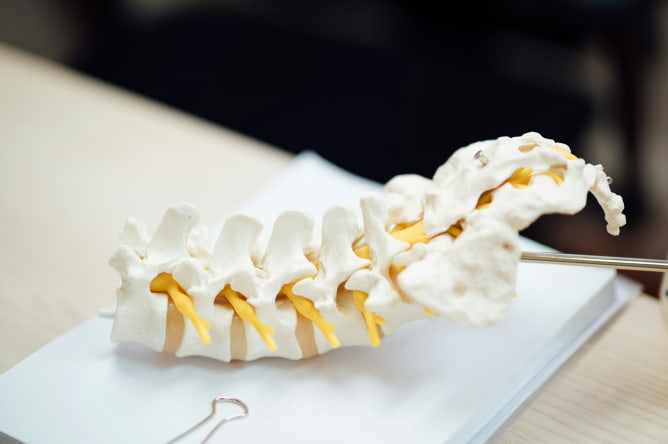
Illustration of spinal cord nerve injury and the clinical need for repair 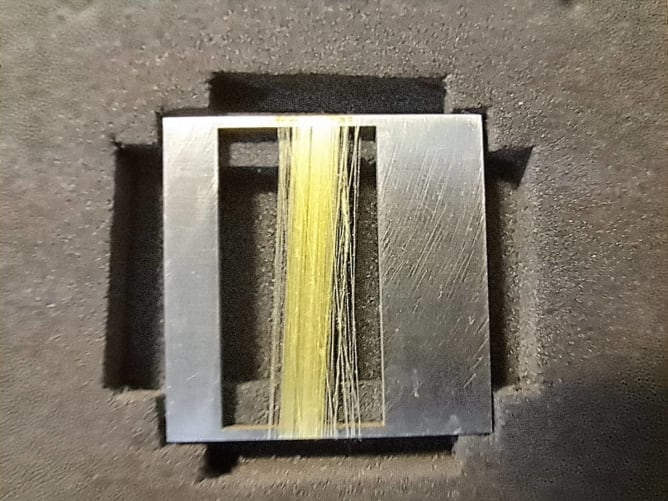
Golden Orb-weaver spider silk, the natural material at the core of our nerve conduit technology
The Problem We're Solving
Here’s what we found when we started looking into nerve repair: the medical field is essentially stuck.
When someone suffers a nerve injury that creates a gap—for example, a severed nerve in the arm, a brachial plexus injury, or damage to the spinal cord—surgeons have three options. They can harvest a nerve from somewhere else in the patient’s body (which means permanently damaging a healthy nerve to fix the injured one). They can use donor nerve tissue from a cadaver (expensive, in limited supply, and only available in some countries). Or they can use a hollow synthetic tube, which works for short gaps but largely fails beyond 3 cm because there’s nothing inside to guide the nerve fibers as they try to grow back.
For spinal cord injuries, the situation is even harder. There is currently no clinically proven treatment that bridges a damaged spinal cord and restores lost neural connectivity. Patients are told the damage is permanent.
And for companion animals, dogs who’ve been in accidents, and horses with nerve injuries, the situation is worse still. Autografts on animals are generally not acceptable from an ethical standpoint, and there are essentially no off-the-shelf alternatives. Many animals with serious nerve injuries end up being euthanized simply because there’s nothing available to treat them.
We think all of this is solvable. And we think spider silk is the key.

The conduit bridges damaged nerve ends, delivering both chemical and electrical signals to stimulate natural nerve repair and regrowth. 
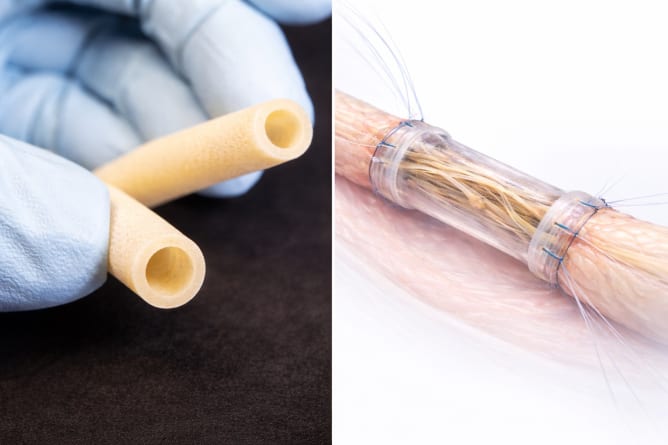
A three-part nerve conduit combining a silkworm silk outer tube, spider silk inner fibres, and a hydrogel loaded with growth factors to guide and support nerve regeneration.
What our conduit does and why it works
Our conduit is a tubular implant, about the size of a small section of drinking straw, made entirely from natural silk proteins. There are no synthetic plastics, no metal components, and no materials that the body needs to remove after surgery.
The outer wall is made from silkworm silk fibroin (the same protein used in surgical sutures for decades; the body knows how to handle it). It’s porous enough for nutrients to pass through, but structured enough to keep scar tissue from growing in and disrupting the repair.
Inside the tube, we thread multiple strands of native Nephila pilipes spider-silk filaments, aligned longitudinally. These act as biological guide rails for regenerating axons, the fibers that carry nerve signals. Schwann cells, which are the body’s key nerve-repair workers, migrate along these silk strands at about 1 mm per day. That’s exactly the rate at which nerve regeneration naturally occurs.
The whole conduit gradually dissolves into harmless amino acids as regeneration completes. There’s no second surgery to remove it. No long-term foreign body in the patient.
The science behind this isn’t theoretical. Researchers at the Medical University of Vienna and the University of Oxford published peer-reviewed studies showing that spider-silk-filled conduits can bridge a 6 cm nerve gap in sheep, with regeneration outcomes that were comparable to using the animal’s own nerve as a graft. That’s the benchmark the entire field works toward. We’ve seen it done. Now we’re building the product that brings this technology off the research bench and into actual clinical use.