Le projet
Et ça repart! Après les élans, place aux singes!
Peut-être que vous vous souvenez de moi et de ma précédente campagne sur We Make It en 2023, qui m’a permis de partir en Alaska pour étudier le comportement des élans..? Plus de 30 personnes ainsi que deux fondations ont soutenu mon project, qui s’est avéré être un véritable succès! Maintenant que ces recherches ont été envoyées pour être publiées dans un journal scientifique, je repars pour de nouvelles aventures!
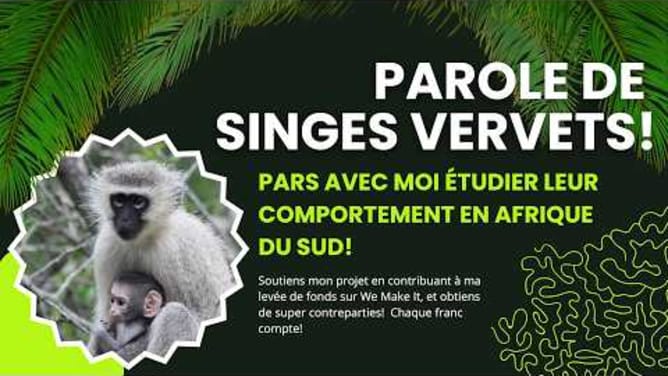
Si je vais continuer dans l’étude du comportment, ça ce passera cette fois-ci dans un environnement bien différent, dans la réserve de Mawana en Afrique du Sud. Je pars dans le centre de recherche de Inkawu Vervet Project, supervisé par la Professeure Van der Waal de l’Université de Lausanne, pour étudier le comportment des singes vervets sauvages.
Après m’être familiarisée avec chaque individu du groupe qui me sera attribué, ainsi qu’avoir complété diverses formations histoire de survivre dans les savanes d’Afrique du Sud, je pourrai contribuer à divers projets de recherches comportementales, sans déranger les singes, bien-sûr!

J’aurai la chance d’être entourée d'une biodiversité incroyable, comme les giraffes. 
Ma formation de terrain m'apprendra notamment à réagir correctement face aux éléphants sauvages de ma réserves. 
Les léopards sont les plus gros prédateurs de ma réserve (et courent jusqu'à 60km/h!).
Pourquoi ça en vaut la peine
Un des axes de recherches principaux se concentre sur la transmission de la culture, que ce soit au niveau des traditions ou des innovations au sein du groupe de vervets. C’est un rouage-clé qu’il nous manque pour comprendre pourquoi chez nous, les humains, nos cultures sont si riches et diverses.
Un autre sujet particulièrement innovateur mêle l’étude comportementale à l’endocrinologie. Nous savons désormais que les hormones (comme l’ocytocine) ont un rôle prépondérant dans les interactions sociales, et lier ces dernières aux observations comportementales permet d’expliquer de nombreuses choses.
Enfin, je participerai à l’étude des vocalises, qui sont très complexes chez les singes vervets, et dont l’évolution est encore peu comprise.
Au-delà des recherches elles-mêmes, envoyer de jeunes chercheur.euses (comme moi!) au centre de recherche Inkawu permet de continuer à le faire vivre, et donne l’opportunité à de nombreux locaux de participer à la protection de leur biodiversité. Le projet a à coeur de les impliquer le plus possible, et leur donne la priorité sur les scientifiques internationaux. Le centre contribue également à sensibiliser les locaux sur l’importance de protéger la nature, et lutter contre le braconnage.
En somme, c’est tout bénèf, tant pour la science et la biodiversité, que pour l’aspect humanitaire!

Les vervets sont de petits singes, qui pèsent entre 4 et 6kg. 
Cette espèce est également présente dans d’autres pays de l’Est de l'Afrique. 
Jusqu'à 50 individus peuvent vivre dans un même groupe! 
Ce sont des singes semi-terrestres, ils vivent donc également partiellement au sol. 
Toutes sortent d'études sont menées dans ce centre de recherche!
À quoi votre soutien va servir
La réalité est que très peu de budget est alloué à la recherche et à la protection de la biodiversité. Même si mon séjour sera en partie défrayé, je ne serai pas payée.
Votre soutien me sera donc utile pour payer quelques frais ennuyeux mais nécessaires (comme mon assurance santé, ou la nourriture), mais également le matériel de terrain dont j’aurai besoin. Déjà équipée d’un super appareil pour vous partager mes plus beaux clichés (@marinebagnoud_ sur Instagram!), ainsi que de jumelles pour mes observations, il me manque encore quelques éléments-clés, comme des habits techniques appropriés aux longues journées passées sous le soleil, ou un équipement ultra-étanche pour les périodes d’averse.
Le terrain, ça rigole pas!

Les températures peuvent être extrêmement chaudes durant l'été, mais tombent dans le négatif en hiver. 
Ma future maison pour huit mois! 
L'écosystème dans lequel je vais évoluer sera du type savane.