
How VRENI began
My grandmother loved folk songs, especially Ländler tunes. They were songs from her childhood that used to play in the kitchen. They still play today when I visit her.
Over time, I noticed that she was doing things differently. Family members suddenly had different names, and the number of post-it notes with reminders kept growing. That was when we realised that my grandmother was living with dementia.
But I also noticed that the illness did not always show itself in the same way. There were recurring moments of clarity, especially when a Ländler tune from her time came on the radio. She seemed happier then, and her eyes became clearer.
That observation stayed with me.
Dementia does not only change memory. It changes everyday life, relationships and entire families. For those affected, it often means agitation, withdrawal, growing isolation and long hours without meaningful activity. For relatives, there is often the painful feeling of having to watch without being able to help.
In care settings too, support and companionship are under pressure. Care work carries an enormous amount, but still receives too little time, recognition and support. People with dementia in particular need familiarity, warmth and simple forms of engagement.
In everyday life, only passive activities often remain. The television runs, but real participation rarely happens. That is the experience that VRENI grew out of.

Ein früher Prototyp von VRENI neben alten Liederbüchern aus der Kindheit — der Ausgangspunkt für das Projekt. 
Erste Entwicklungsversion: Raspberry Pi, Lautsprecher und Elektronik auf dem Arbeitstisch. 
Der Entwicklungstisch in Zürich — hier entstand VRENI Schritt für Schritt. 
Das Gehäuse von VRENI entsteht im 3D-Drucker — jedes Teil wird selbst entwickelt und gefertigt. 
Früher Holzprototyp von VRENI — das warme Material macht das Gerät vertraut und greifbar. 
Entwicklung des Gehäuses: 3D-gedrucktes Modell mit Aufschrift «VRENI» neben den Elektronikbauteilen.
What VRENI is
VRENI is reduced to the essentials: one button, one clear function, no searching, no scrolling. Its design is inspired by transistor radios — familiar to a generation that grew up with them.
Technology should adapt to people, not the other way around.
At the push of a button, VRENI tells personal stories: from a person’s life, from familiar places, music, habits and memories. Once set up, the device can be used directly in everyday life.
I have developed, tested and improved VRENI step by step over the past months. What became clearer and clearer to me: it is not about technology for its own sake, but about something that is genuinely helpful in daily life.
VRENI is meant to create calm, spark attention and make moments of closeness possible. The first care institutions are already reaching out, and relatives are asking about it too.
With this campaign, I do not want to keep developing VRENI in isolation, but together with people who will actually use it in everyday life.
When you support a test spot, you help develop VRENI where it really matters: at home, in families and in care settings. This direct feedback is especially valuable to me.
The money from this campaign goes into the next development round, into more test devices and into supporting the first applications.
When we reach our goal of CHF 20,000, we will produce the first test devices and accompany the first households and care settings from August 2026 onwards as they start using VRENI. I will answer questions personally and share transparently what we learn along the way.
And if we reach more:
From CHF 35,000: We will fund a first scientifically accompanied pilot validation to develop VRENI on a well-founded basis. This will give us structured insights into how VRENI affects calm, engagement, agitation and everyday usability.
From CHF 45,000: We will invest in the next product iteration of VRENI: a further developed natural wood housing instead of 3D printing, first steps towards fair manufacturing in a supported workshop, and technical refinement of key functions for everyday use.

VRENI in Terracotta — angelehnt an klassische Transistorradios, mit einem einzigen Knopf. 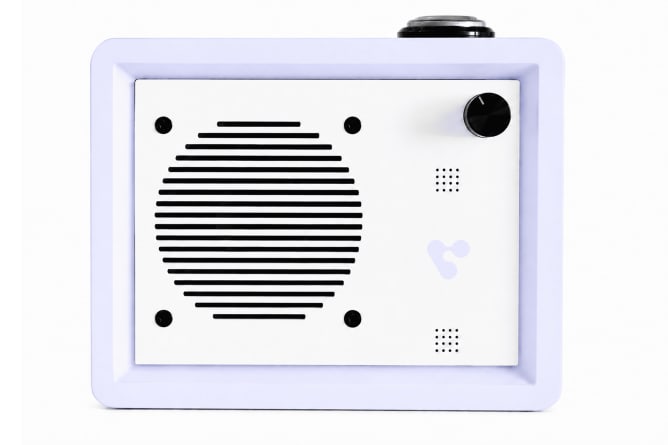
VRENI in Weiss — schlicht und vertraut, passend in jeden Haushalt. 
VRENI in Rot — das Gerät ist in verschiedenen Farben erhältlich. 
VRENI in Lila — anpassbar an persönliche Vorlieben. 
VRENI in Walnussholz — natürlich und warm. 
VRENI in heller Eiche — zeitlos und zurückhaltend. 
VRENI in Cremé — ruhig und einladend.
Why this matters to me
Dementia is not only a medical or caregiving challenge. It can also strain relationships, intensify overload and make people especially vulnerable in everyday life.
As a woman, this issue is especially close to my heart. What concerns me is not only what dementia does to memory, but also what it can do to relationships, dependency and people’s vulnerability in daily life.
Studies show that women are far more often affected by domestic violence over the course of their lives, and that people with dementia in home settings face an increased risk of experiencing violence. When cognitive impairment is combined with agitation, overload and a lack of support in everyday care, situations can escalate and put people at even greater risk.
In the context of dementia, agitation refers to distressing states such as inner restlessness, strong irritability, motor unrest or impulsive defensive reactions, which are often expressions of fear, overload or disorientation.
I do not believe that a product can solve such problems. But I do believe that good companionship in everyday life can relieve pressure, bring calm and help prevent difficult situations from escalating.
As a woman and founder, I want to show with VRENI that technology in the care sector can be designed with empathy, accessibility and everyday relevance. I hope this project encourages other women to bring their own experiences, perspectives and ideas into innovation. For me, VRENI is also proof that people from cultural backgrounds can not only name societal problems, but also develop concrete solutions.
I am Jasmin from Zurich and have been developing VRENI since 2025 in dialogue with families, professionals and care institutions. My goal is something that is genuinely helpful for people with dementia in their everyday lives.
